- (407) 774-8324
- JDMFlorida@gmail.com
 Login
Login


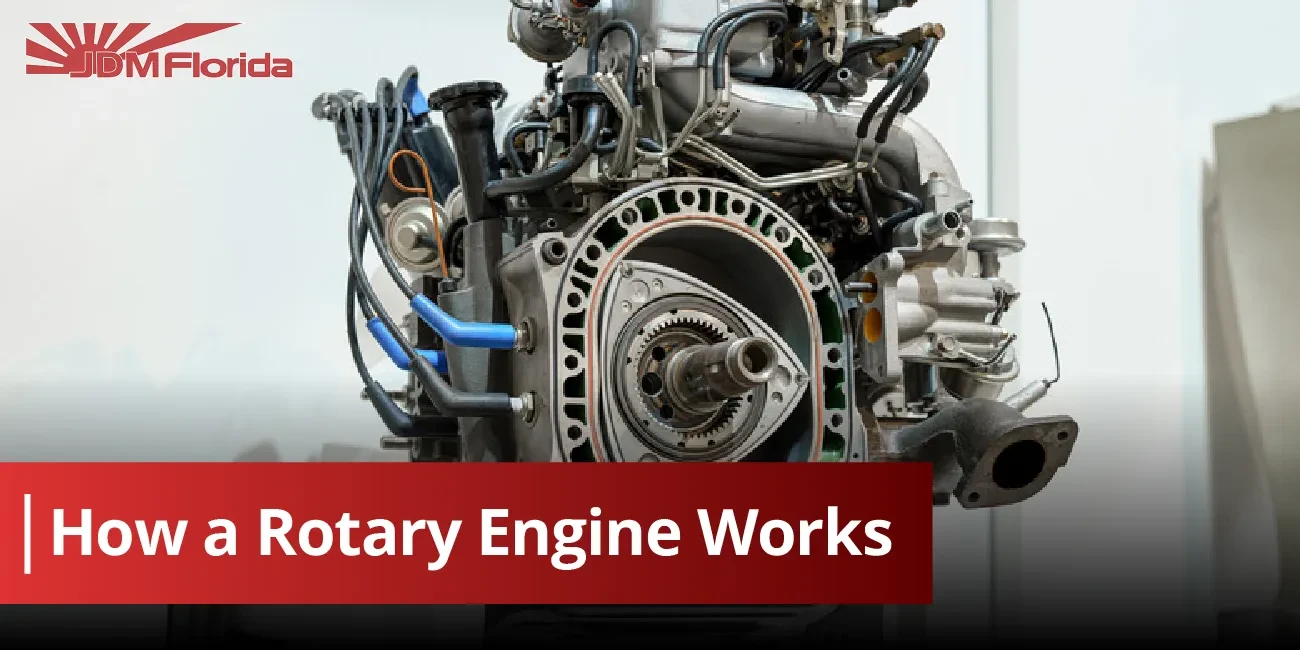
How a Rotary Engine Works: The Mazda 13B Explained
A rotary engine doesn't work like the engine sitting under most hoods today. Instead of pistons pumping up and down, a rotary engine spins a triangular rotor inside an oval housing. That single design choice changes everything about how the engine sounds, revs, and performs. Mazda built its reputation on this idea, and the 13B is the engine most people picture when they hear the word rotary.
What is a rotary engine?
A rotary engine is a type of internal combustion engine that uses a spinning rotor instead of pistons. German engineer Felix Wankel developed the core design in the 1950s, which is why people also call it a Wankel rotary engine. The rotor is shaped like a rounded triangle, and it spins inside a housing shaped like a figure eight. As it turns out, the rotor's three points always stay in contact with the housing wall.
That contact creates three separate pockets of space. Each pocket handles a different job at any given moment. One might be pulling in air and fuel while another is compressing it, and a third is pushing out exhaust. So, instead of one cylinder doing four jobs one after another, a rotary engine has three chambers doing different jobs at the same time, all within one housing.
How does a rotary engine work?
Once you understand the basic setup, the process itself isn't complicated. A rotary engine still needs air, fuel, compression, and a spark, just like any gas engine. It just gets there differently.
The Wankel design and the spinning rotor
The rotor sits on an eccentric shaft, which is the rotary version of a crankshaft. As the rotor spins around this shaft, its three tips sweep past the intake port, then the spark plugs, then the exhaust port. Each face of the rotor completes intake, compression, combustion, and exhaust once per rotor revolution. Because the rotor has three faces, one full spin produces three power pulses. That's a big reason rotary engines feel so smooth and rev so freely compared to piston engines.
Intake, compression, combustion, and exhaust in one housing
Picture the housing as one continuous loop with no internal parts blocking it. As a section of the rotor sweeps past the intake port, it draws in air and fuel. The rotor keeps turning, and the space shrinks, which compresses that mixture. Once it reaches the spark plugs, the mixture ignites and pushes the rotor forward. The same motion opens the next section to the exhaust port, and the burnt gases get pushed out. This entire cycle repeats itself continuously, without a single valve opening or closing.
Apex seals and why they matter
The three tips of the rotor use small metal strips called apex seals. These seals press against the housing wall and keep each combustion chamber sealed off from the others. Without a tight seal, pressure leaks between chambers and the engine loses power fast. Apex seals take a beating because they're constantly under pressure and heat, and they're usually the first thing to wear out on an older rotary. Anyone shopping for a used or imported 13B should ask directly about apex seal condition before buying.
Rotary engine vs piston engine: the key differences
People often ask how a rotary engine stacks up against a traditional piston engine, and the differences go beyond just the moving parts.
Power-to-size ratio and high RPM character
A rotary engine has far fewer moving parts than a piston engine. There's no crankshaft, no camshaft, no valve springs, and no timing chain to worry about. Fewer parts means less rotating mass, and that lets a rotary rev much higher than most piston engines before it runs into mechanical limits. Many rotary engines comfortably spin past 8000 RPM, and some tuned setups push even higher. This is part of why small rotary engines can produce surprising power for their physical size.
Fuel economy and oil consumption trade-offs
The drawback is efficiency. A rotary engine burns fuel less completely than a piston engine because of its combustion chamber shape, so fuel economy usually suffers. Rotary engines also burn oil on purpose, since a small metered amount lubricates the apex seals and rotor housing. Owners need to check oil levels more often than they would with a typical piston engine. If fuel economy is your top priority, a rotary probably isn't the right choice.
The Mazda 13B: the most famous rotary engine
Mazda didn't invent the rotary engine, but the company is the reason most people know about it today. The 13B became Mazda's signature engine and stayed in production for decades, which says a lot about how much the company believed in the design.
13B variants: 6 port, twin turbo REW, and Renesis
The 13B went through several major versions over its lifespan. Early naturally aspirated versions used a 6-port intake design for solid low-end response. The 13B REW added twin turbochargers and became famous for its role in the third-generation RX-7, delivering serious power from a relatively small engine. Later, Mazda redesigned the engine again for the RX-8 and called it the Renesis. This version used side intake ports instead of peripheral ports, which improved emissions and helped the engine meet stricter regulations at the time.
What the 13B powered: the RX-7 and RX-8
The 13B is best known for powering the RX-7, particularly the twin-turbo FD generation that many enthusiasts still consider one of Mazda's best cars. It also powered the RX-8 in its Renesis form, giving that car a genuinely unique driving feel compared to anything else on the market. If you've ever heard someone talk about the rotary engine rx7 combination with real excitement, this is the engine they mean.
Are rotary engines reliable?
This question comes up constantly, and honestly, it depends on how the engine was maintained. Rotary engines aren't inherently fragile, but they are less forgiving of neglect than most piston engines.
Common failure points and how to avoid them
Apex seal wear is the most common issue, especially on engines that were run hard without regular oil checks. Flooding is another common problem, since rotary engines can struggle to start after sitting for a while or after a few failed cold start attempts. Overheating is also a bigger risk than most people expect, since the housing runs hotter than a piston engine's block in certain areas. Keeping the cooling system in good shape goes a long way toward avoiding major problems.
Maintenance that extends rotary engine life
Regular oil top-offs matter more here than with almost any other engine type. Spark plugs wear out faster too, since rotary engines run through more combustion cycles per minute. Routine compression testing can catch apex seal wear early, before it turns into a bigger repair. None of this maintenance is difficult, but it does need to happen consistently. Owners who stay on top of it tend to get many reliable years out of their 13B.
Where to buy an imported 13B rotary engine
If you're looking to bring genuine JDM power to your build, JDM Florida's Mazda engine inventory is worth checking before you buy from anywhere else. We import low-mileage 13B engines straight from Japan, and every unit gets checked for compression and overall condition before it's listed. That matters a lot with rotary engines, since a compression check tells you far more about apex seal health than mileage alone ever could.
Buying imported also tends to get you a cleaner engine overall. Japanese import regulations push older vehicles off the road earlier than in the US, so many of these engines come from cars with genuinely low hours on them. If you want a deeper technical breakdown of the four-stroke cycle a rotary replaces, HowStuffWorks has a solid explainer on how rotary engines work that pairs well with everything covered here.
Rotary engine FAQs
How long do rotary engines last?
A well-maintained 13B can last well past 100,000 miles, though many owners see issues show up sooner if oil checks and cooling maintenance get skipped. Engines that were driven gently tend to outlast those that saw constant hard use without proper care.
How much horsepower does a 13B make?
It depends heavily on the variant. Naturally aspirated 13B engines typically produce somewhere around 135 to 160 horsepower in stock form. The twin turbo REW found in the FD RX-7 pushed closer to 255 to 276 horsepower from the factory, and tuned versions can go well beyond that with the right supporting mods.
Is a rotary engine hard to work on?
It's different, not necessarily harder. A rotary engine has fewer parts overall, so some jobs are actually simpler than on a piston engine. However, finding a mechanic who genuinely understands rotary engines can be tricky outside of enthusiast circles. So, it helps to find a shop with real 13B experience before you need major work done.