- (407) 774-8324
- JDMFlorida@gmail.com
 Login
Login


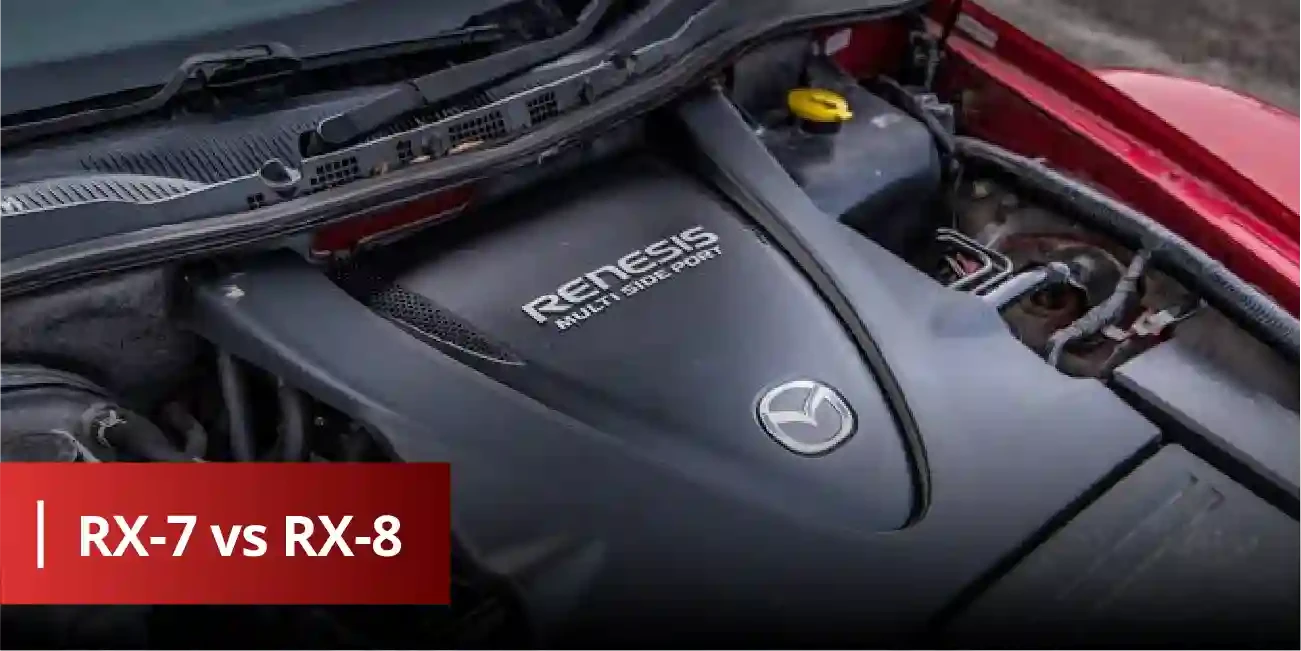
RX-7 vs RX-8: Which Mazda Rotary Should You Buy?
RX-7 vs RX-8 is one of those debates that never really dies in the Mazda world, and honestly, it should not. Both cars run on rotary power, both wear the Mazda badge with pride, and both have loyal fans who will defend their pick until the end of time. But they are actually very different machines under the skin. If you are trying to decide which one fits your build, your budget, or your daily life, this guide breaks down exactly what separates them.
Rotary engines already put these cars in a small club on their own. Very few manufacturers ever committed to the rotary the way Mazda did, and both the RX-7 and RX-8 are proof of just how far that commitment went. Understanding what makes each one different is the first step to figuring out which one actually belongs in your garage.
RX-7 vs RX-8, Quick Spec Comparison
Before we go deep on each car, here is a fast side by side so you can see where they differ right away.
Right away you can see these two cars were built for slightly different missions. The FD was built to be a raw, focused sports car. The RX-8 was built to bring rotary power to more people without giving up daily usability.
Mazda RX-7 FD3S, The 13B-REW Twin-Turbo Icon
The FD3S generation RX-7 is the one most people picture when they hear the name. It is the version from Initial D, from countless movies, and from decades of tuner culture. Under the hood sits the 13B-REW, a sequential twin turbo rotary that was genuinely ahead of its time when it launched.
Sequential turbo setups are not simple. A small turbo spools first for quick low end response, then a second larger turbo kicks in as RPM climbs, smoothing out what would otherwise be a rough power delivery. Mazda got this system dialed in well enough that the FD still feels responsive today, decades later.
The FD's chassis is another huge part of its reputation. It is light, low, and built around driver feedback rather than comfort. This is not a car that coddles you. It rewards a driver who is paying attention and punishes one who is not. That razor's edge feel is exactly why it became such an icon in drift and grip circles alike.
Styling plays a part too. The FD's curves still look modern decades later, and that timeless design is a big reason values have climbed so much. It does not look like a product of its era the way a lot of nineties cars do. It looks like something designed with no expiration date, which is part of why collectors keep chasing clean examples even now.
Mazda RX-8, The Renesis 13B-MSP
The RX-8 took a completely different approach. Instead of turbocharging, Mazda redesigned the rotary housing itself with the Renesis engine, moving the exhaust ports to the side instead of the periphery. This let the engine rev much higher and breathe better at high RPM, all without forced induction.
The result is a naturally aspirated rotary that loves to spin past 8,000 RPM and makes a sound unlike almost anything else on the road. It is not about torque. It is about that high revving, screaming character that rotary fans chase.
The RX-8 also brought something the FD never had, real practicality. With its unique rear suicide doors and small back seats, it could actually work as a semi daily car. Four seats, four doors, and rotary power all in one package was a genuinely unique offering when it launched, and honestly still is.
The chassis was tuned with a near perfect front to rear weight balance, thanks to the compact size of the rotary engine sitting low and far back in the engine bay. That balance shows up the moment you push the car into a corner. It feels planted and predictable in a way that few affordable sports cars manage, turbo or not.
Rotary Explained, 13B-REW vs Renesis
Both engines are 1.3 liter twin rotor rotaries, but they could not be more different in how they make power.
13B-REW: sequential twin turbo, forced induction, strong torque especially with the second turbo online, tuner favorite for big power builds
Renesis 13B-MSP: naturally aspirated, side exhaust port design, higher redline, smoother power delivery but more sensitive to overheating and flooding if not driven right
The 13B-REW is generally considered the stronger base for serious power builds because it already comes with turbos and a proven aftermarket. The Renesis can be built up too, but it usually needs a lot more work and money to get anywhere near FD power levels, and even then, longevity becomes a real concern.
Something worth knowing if you are new to rotaries, both engines still need premix oil injection to keep the apex seals lubricated, and both still burn a small amount of oil as normal operation, not a sign of failure. This trips up a lot of first time rotary owners who assume any oil use means something is wrong. Checking and topping oil regularly is just part of rotary ownership, not a red flag on its own.
Reliability, Which Rotary Lasts Longer?
This is the question everyone actually wants answered, and the honest truth is neither rotary is famous for bulletproof reliability. Rotary engines as a category wear apex seals over time, and both of these engines need consistent maintenance and the right driving habits to last.
That said, there are differences worth knowing.
RX-7 reliability tends to come down to turbo seals, cooling system health, and whether the car was ever driven hard cold. A well maintained FD can last a long time, but a neglected one falls apart fast.
RX-8 reliability issues are often tied to flooding. If the car sits without being driven regularly, or if someone does not warm it up properly, the Renesis can flood and foul plugs. Regular driving actually helps this engine stay healthy.
Both engines need oil injection systems working correctly, since rotaries burn a small amount of oil by design to lubricate the apex seals.
Neither car is a "buy and forget" machine. Both reward owners who actually understand rotary maintenance and punish owners who treat them like a normal piston engine.
Power & Driving Feel
The FD's twin turbo setup gives it a completely different character than the RX-8. Boost comes on, torque builds, and the car pulls hard through the midrange in a way the naturally aspirated RX-8 simply cannot match. It feels like a proper sports car turbo engine, aggressive and eager.
The RX-8 trades that torque for a rev happy, high strung personality. It wants to be spun out near redline to feel its best. Driven that way, it delivers a smoothness and sound that turbocharged engines cannot replicate. Driven like a normal commuter car, it can feel a bit flat down low.
Neither approach is objectively better. It comes down to what kind of driving experience you actually want behind the wheel.
Sound is a big part of this decision too, more than people expect. The FD has that deep turbo spool followed by a hard edged rotary snarl once boost hits. The RX-8 sings, almost like something between a motorcycle and a small race engine once it gets up near redline. If you have never heard either in person, it is worth finding a local meet or a video with real in car audio before you decide, because this is genuinely part of the appeal for a lot of rotary fans.
Swaps, Rebuilds & Keeping a Rotary Alive
Because both engines eventually need attention, most long term rotary owners end up facing a choice at some point, rebuild the factory engine or look into a rx8 engine swap.
Common paths owners take:
Rebuild the factory 13B: keeps things period correct, but rotary rebuilds are specialized work and not every shop does them well
Swap in a fresh or upgraded 13B: a common route for RX-8 owners looking for more reliable long term performance without a full engine change
LS swap: popular among RX-8 owners who want big power and easier long term reliability, though it means giving up the rotary character entirely
Turbo Renesis builds: possible, but expensive and still limited by the engine's inherent housing design
If keeping the rotary character matters to you, sourcing a quality rebuilt or low mileage 13B is usually the better route over trying to nurse a tired one along. Parts and expertise for rotary work are more specialized than typical piston engines, so working with someone who actually understands these motors makes a real difference.
Price & Availability
The FD3S RX-7 has become a genuine collector car. Clean, unmodified examples now carry serious price tags, and even rough project cars are not cheap anymore. If you want an FD, expect to pay a premium simply for the badge and the reputation attached to it.
The RX-8 is a different story. It is still relatively affordable to get into, especially compared to the FD. That makes it a more approachable entry point into rotary ownership, even if it means accepting the maintenance quirks that come with the Renesis engine.
If budget is a major factor, the RX-8 opens the door to rotary ownership without the FD's collector car pricing.
It is also worth thinking about long term value, not just the sticker price today. FD prices have been climbing steadily for years and show no signs of slowing down, which makes it a stronger long term investment if you can afford the entry cost. RX-8 prices have stayed much flatter, which is great news for buyers but means it is less likely to appreciate the way the FD has. Depending on your goals, that difference might matter just as much as the driving experience itself.
Which Should You Buy?
Here is a simple way to decide based on what actually matters to you.
Go with the RX-7 if:
You want the raw two seat sports car experience
Turbo torque and that iconic FD look matter to you
You are prepared for collector car pricing and dedicated maintenance
Go with the RX-8 if:
You want rotary power with more practicality, seats, and doors
You prefer a high revving, naturally aspirated character
You want a lower cost entry point into rotary ownership
Both cars share the same soul, that unmistakable rotary sound and spin, just wrapped in very different packages. There is no wrong answer here, only the answer that fits your goals.
Talk to owners of both if you get the chance before you commit. Nothing explains the difference between these two cars better than actually hearing them run and feeling how each one responds under throttle. Specs on a page can only tell you so much about a rotary, the rest you really do have to experience firsthand.
Ready to Source Your Rotary?
Whether you are chasing a fresh 13B-REW for your FD or looking into an rx8 engine swap, check out our Mazda Rotary collection for verified, tested rotary engines ready to power your next build. Every unit is checked and documented before it ships, so you can build with confidence instead of guessing about condition.