- (407) 774-8324
- JDMFlorida@gmail.com
 Login
Login


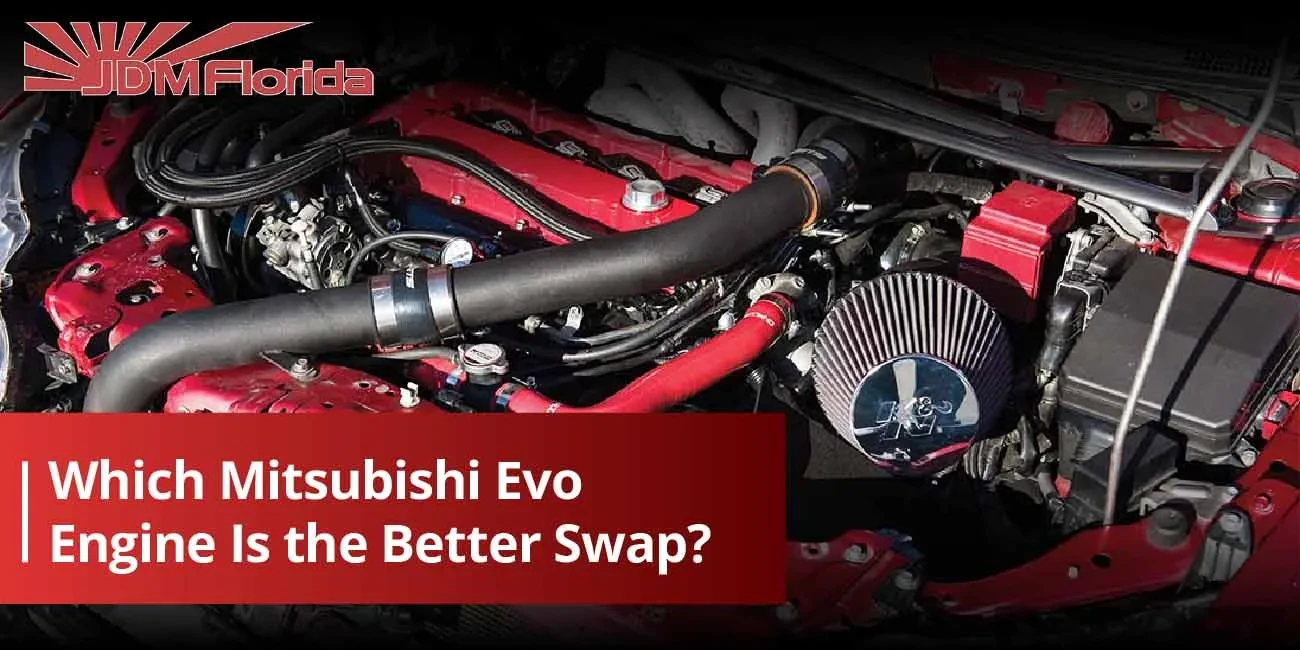
4G63 vs 4B11: Which Mitsubishi Evo Engine Is the Better Swap?
The Mitsubishi Lancer Evolution ran nine generations on the legendary 4G63T turbo. Then Evo X arrived with the 4B11T and changed the game. Both are 2.0L turbocharged 4-cylinders. Both make 280+ HP from the factory. Both have massive tuning followings.
But they're very different engines under the hood.
So which one should you actually buy? Here's the full breakdown: Power, reliability, tuning headroom, swap difficulty, and price.
4G63 vs 4B11 — Quick Comparison
Here is the comparison table for two of Mitsubishi's rally-bred engines: the iconic cast-iron 4G63T (which powered the Evolution series for decades) and its modern, all-aluminum successor, the 4B11T (introduced for the Evolution X).
While the 4G63T is famous for its nearly indestructible iron block and massive aftermarket legacy, the 4B11T brought modern weight savings, advanced MIVEC variable valve timing on both cams, and a highly robust semi-closed deck design.
4G63T — The Evo IV–IX Workhorse
The 4G63T is one of the most iconic JDM engines ever made. It powered the Evo from Gen IV to Gen IX. That’s over a decade of factory rally performance.
Key specs and facts:
Cast iron block — heavy but nearly indestructible
Alloy head — keeps weight down on top
Two crank versions exist: 6-bolt and 7-bolt (important — more below)
30+ years of aftermarket support
Parts are everywhere and affordable
Massive community of builders who've documented every mod
The 4G63T has a reputation for being bulletproof when properly maintained. It loves boost, responds to basic mods fast, and has been making serious power since the early 90s. This engine just doesn't quit.
4B11T — The Evo X Modern Successor
The 4B11T was a full redesign for Evo X. Mitsubishi went modern. Aluminum block, MIVEC variable valve timing, and a completely different bore/stroke setup compared to the 4G63.
Key specs and facts:
Aluminum block — lighter and better thermal management
MIVEC variable valve timing — better low-end response and improved fuel economy
Different internal dimensions — not cross-compatible with 4G63 parts
Smoother power delivery across the rev range
Aftermarket is growing quickly but still not as deep as 4G63
The 4B11 is more refined and more comfortable to use daily. But it's also newer, which means fewer budget used parts and a smaller swap ecosystem right now.
Power Comparison
While both engines are absolute monsters when modified, they achieve their power in very different ways. The 4G63T relies on its bulletproof iron block and decades of cheap, readily available parts. On the other hand, the 4B11T utilizes a modern, rigid aluminum semi-closed deck design that allows it to actually hold more power on completely stock internals (though you will pay a premium to get it there).
The Takeaway: If you want a cheaper path to 500–600 HP with endless cheap parts availability, the classic 4G63T is king. If you want a modern, highly refined platform that can push past 700 HP on the stock block internals, and you have the budget to support it, the 4B11T is the answer.
Reliability — 6-Bolt vs 7-Bolt 4G63
This is one of the most important details when buying a 4G63 engine for sale. The 4G63T came in two crankshaft versions:
Always verify which crank you're getting. For any serious build, 6-bolt is non-negotiable.
The 4B11T has its own quirk. Early versions had oil control ring issues that caused excess oil consumption. It's a known problem with a known fix, but always check maintenance history and oil condition on any used 4B11.
Tuning Headroom & Aftermarket Support
The 4G63 wins on aftermarket depth. No contest. You can find budget bolt-ons all the way to full race setups at every price point. The 4B11 aftermarket is catching up fast, but it's simply not there yet.
Swap Difficulty
4G63T swaps:
Classic DSM chassis swaps (Eclipse GSX, Galant VR-4) are well documented
Tons of ready-made kits and guides available
Wide range of transmission options
Large community of builders who've already solved every problem
4B11T swaps:
Less common and more complex
Fewer ready-made swap kits currently available
Better suited for Evo X-specific builds
Growing swap community but still catching up
If you're dropping an engine into an older chassis, the 4G63 is significantly easier to work with.
Price Comparison
Prices vary by mileage and condition. The 4G63 is generally cheaper to buy and cheaper to build to big numbers.
Which Should You Buy?
Vintage Evo restoration (Evo IV–IX) → 4G63T — it's the correct engine for the chassis
DSM build (Eclipse GSX, Galant VR-4) → 4G63 — period correct and easy to source
Modern high-power build → 4B11T — more potential with the right budget
Budget build → 4G63 — deeper aftermarket, lower cost to build
Both engines are genuinely legendary. The 4G63 is the classic. Proven, affordable, and has more aftermarket support than almost any JDM engine alive. The 4B11 is the natural evolution. More refined and capable of even more power when you go all-in.
No one wants to pull a motor twice. At JDM Florida, we take the gamble out of your next swap by sourcing premium, low-mileage powertrains directly from Japan. Every single engine undergoes a rigorous inspection and testing process before being securely shipped straight to your garage door.
Browse our JDM Mitsubishi engines including 4G63 engines for sale. Don't forget to check Mitsubishi transmissions to complete your build.