- (407) 774-8324
- JDMFlorida@gmail.com
 Login
Login


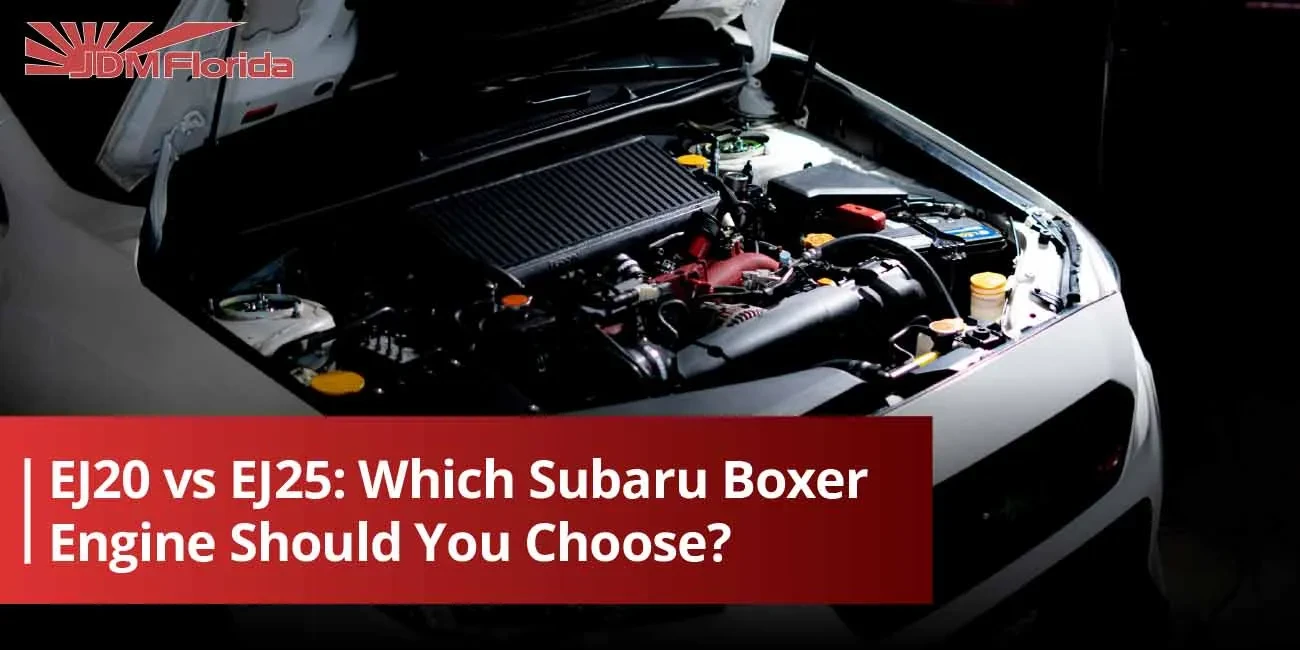
EJ20 vs EJ25: Which Subaru Boxer Engine Should You Choose?
Shopping for a JDM Subaru engine? You've already narrowed it down to two families: the EJ20 and the EJ25. Both are flat-four boxers. Both powered iconic WRX and STi generations. Both have serious tuning followings.
But they're not the same engine, and the wrong choice can cost you real money.
This guide breaks down everything. Displacement, power, reliability, swap fitment, and cost, so you can pick the right Subaru WRX engine for your build.
EJ20 vs EJ25 — Quick Comparison
While the 2.0L EJ20 (especially the legendary JDM EJ207) is famous for its incredible reliability, resistance to detonation, and screaming 8,000 RPM redline, the 2.5L EJ25 is the backbone of the USDM performance lineup, offering massive low-end torque and immediate throttle response with only a slightly lower redline.
EJ20 — The Classic 2.0L Boxer
The EJ20 is the original WRX engine. It's rev-happy, lighter than the EJ25, and has been the foundation of JDM performance since the early 90s.
Where it's used:
JDM WRX (1992–2014)
WRX STi V7/V8/V9 (JDM spec)
Forester XT (EJ205 variant)
Legacy GT (select variants)
Strengths:
Loves to rev — top-end power delivery is genuinely exciting
EJ207 (STi spec) is one of the most desirable JDM Subaru engines ever built
Lighter than EJ25 — better weight balance
Deep JDM tuning roots and community knowledge
Weaknesses:
Less low-end torque — can feel lazy below 3,000 RPM
Smaller displacement limits power gains without serious work
EJ207 availability is tightening as supply shrinks
EJ25 — The Bigger 2.5L Boxer
The EJ25 came in to answer the market's demand for more torque and easier daily drivability. It's been the engine of choice for USDM WRX and STi since 2004 and is genuinely more liveable on the street.
Where it's used:
USDM WRX and STi (2004 onward)
Forester XT
Outback XT
Legacy GT
Strengths:
Strong low-end torque — pulls hard from low RPM
Better for daily driving and traffic
EJ255 and EJ257 both have good tuning potential
Easier to make big power thanks to the displacement advantage
Weaknesses:
Early EJ257 (2004–2007) had well-documented rod bearing issues when run on degraded oil or abused
Heavier than EJ20 — slightly impacts handling balance
Less exciting top-end character compared to EJ20
EJ20 Variants — V7 / V8 / V9 / EJ207 STi
The EJ207 is the crown jewel of the EJ20 family. It features a twin-scroll turbo, sodium-filled exhaust valves, and factory forged internals. It was built for rally-spec performance, and it shows. If you want true JDM STi character, there's no substitute.
EJ25 Variants — EJ255 vs EJ257
The EJ257 is the performance variant. Later versions (2008+) addressed the rod bearing issues of early units and came with forged pistons and a stronger short block, making them a solid foundation for a built engine.
Power Output & Tuning Headroom
Understanding the Subaru EJ Tuning Path
The EJ205 and EJ255 are built for entry-level fun. They are the budget-friendly options. They make great daily drivers. However, they use weaker factory internals. Because of this, they have less headroom for massive power.
The EJ207 and late EJ257 are the heavy hitters. They are neck-and-neck for ultimate tuning potential. The JDM EJ207 relies on high RPMs, thick cylinder walls, and incredible block strength. The USDM EJ257 uses sheer displacement and massive low-end torque to make its power. Both hold high boost very well.
Reliability — Real-World Experience
EJ20 reliability:
Very reliable with regular maintenance
EJ207 is tough — it was factory-built for rally racing stress
Uses a timing belt, not a chain — must be replaced on schedule
Watch for head gasket wear on high-mileage JDM units
EJ25 reliability:
EJ255 is one of the most reliable Subaru engines — genuinely great daily motor
Early EJ257 (2004–2007) has a known rod bearing problem — always check oil maintenance history
Later EJ257 improved significantly after Subaru addressed the issue
Timing belt service is still critical — don't skip it
Both engines reward consistent maintenance. Neglect them and they'll let you know about it.
Cost Comparison
Subaru engine prices are changing fast, and your budget dictates your choice.
The legendary JDM EJ207 is becoming rare. Clean supply in Japan is shrinking, causing importer prices to climb every year. Despite the high cost, finding a verified, low-mileage EJ207 is absolutely worth paying for. Its thick cylinder walls, forged internals, and high 8,000 RPM redline offer unmatched reliability for high-power builds. It saves you money on future repairs.
Conversely, the USDM EJ255 is the most affordable entry point if your budget is tight. Because Subaru used this 2.5L engine in many models—like the WRX, Forester XT, and Legacy GT—the market is flooded with them. Prices stay low and parts are cheap. It lacks the big power headroom of the EJ207, but it makes a highly affordable, torquey daily driver.
Buy the EJ207 for ultimate performance, or the EJ255 to save cash.
Which Should You Choose?
Want JDM character and love to rev → EJ20 / EJ207 — hits different above 5,000 RPM
Want more torque and daily drivability → EJ25 / EJ255 — the practical choice
Big power build on a budget → Late EJ257 — strongest foundation for a built motor
Period-correct JDM restoration → match whatever the chassis originally came with
Budget street build → EJ255 — affordable, reliable, proven
The EJ20 is for people who want that high-rev JDM feel. The EJ25 is for people who want torque, ease, and room to grow. Both are great. It just depends on what you're building.
Doing your build right the first time requires a powertrain you can actually trust. At JDM Florida Depot, we import clean, low-mileage engines directly from Japan to ensure your project goes smoothly.
Our team takes care of the hard part: every bundle is meticulously inspected, thoroughly tested, and safely prepared for flawless delivery directly to your doorstep.
Shop our JDM Subaru engines, EJ20, EJ207, EJ255, and EJ257 all available. Check out STi 6MT vs WRX 5MT and browse our JDM Subaru transmissions to match your swap.