- (407) 774-8324
- JDMFlorida@gmail.com
 Login
Login


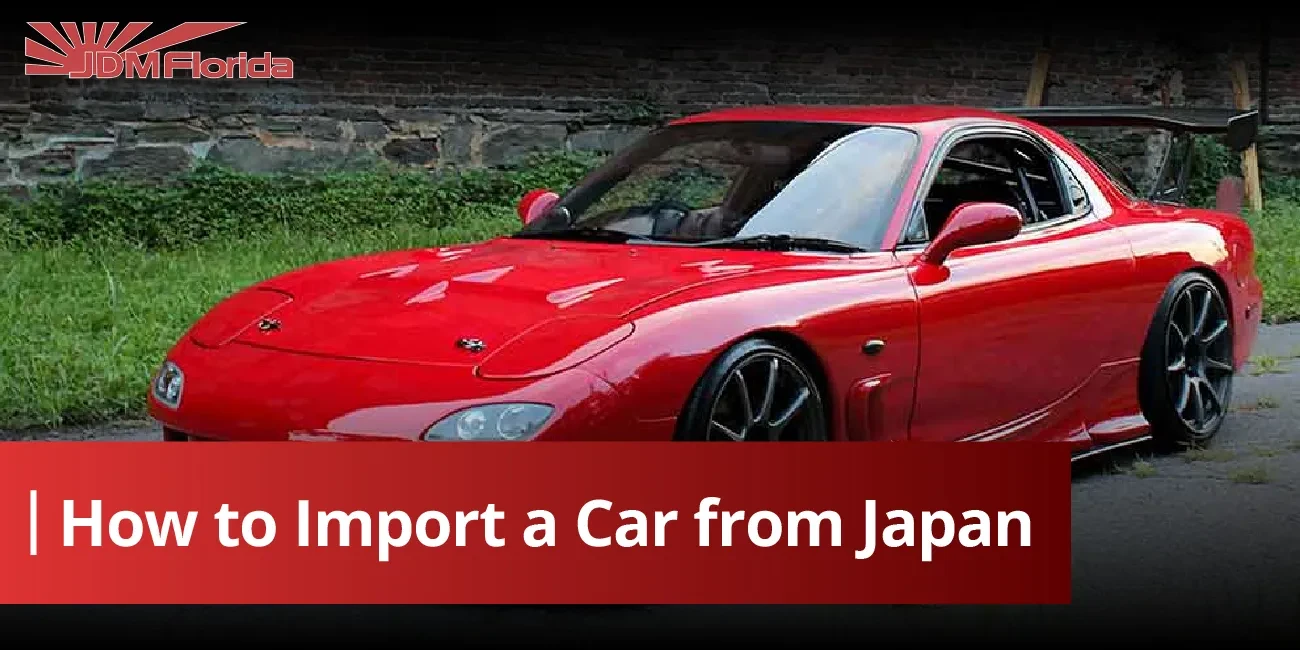
How to Import a Car from Japan: Cost, Steps & the 25-Year Rule
Importing a car from Japan sounds like a dream until you start Googling it and get ten different answers about cost, rules, and timelines. This guide clears it up. We'll cover how much it actually costs, what the 25-year rule really means, and the exact steps to bring a JDM car home legally.
Can you import a car from Japan to the US?
Yes, but there are rules around which cars qualify and when. The US doesn't let just any foreign-market car roll in. Two federal agencies control this: NHTSA (safety) and the EPA (emissions).
The 25-year import rule explained
The 25 year import rule says a vehicle 25 years or older, counted from its actual month and year of manufacture, is exempt from FMVSS (Federal Motor Vehicle Safety Standards). No crash testing, no safety retrofits needed. This exemption comes from the Imported Vehicle Safety Compliance Act of 1988 and it's still the main path most people use to legally import a JDM car.
There's a separate rule for emissions. The EPA exempts vehicles 21 years or older, but only if the engine is the original one the manufacturer installed. Swap the engine and you could lose that exemption, so this matters if you're eyeing a car that's had engine work done overseas.
Here's the part people miss: eligibility is based on the exact manufacture date on the vehicle's compliance plate, not the model year. A car built in October 2000 doesn't become eligible until October 2025. Every January 1st, a new production year crosses the line, which is why certain JDM legends suddenly "become legal" each year.
What's legal to import now (and what isn't)
As of 2026, cars built through 2001 are becoming eligible as they individually hit their 25-year mark. That includes cars like the EP3 Civic Type R, the S15 Silvia Spec-R, and early E46-generation cars. Anything newer than that generally isn't importable for road use unless it qualifies for a narrow exception:
Show or Display exemption, for a short NHTSA-approved list of historically or technologically significant vehicles, capped at 2,500 miles a year
Registered Importer route, where a certified importer brings a non-conforming car into compliance, which is expensive and can run anywhere from roughly $9,500 to $28,500 depending on the vehicle
Closed-course competition only vehicles, which can never be registered for the street
For most buyers chasing a Japanese car auction find, the simplest and cheapest path is still waiting for the car to clear the 25-year mark.
How much does it cost to import a car from Japan?
This is the number everyone actually wants. There's no single flat fee, but here's a realistic breakdown of where your money goes.
Auction / purchase price
This is obviously the biggest variable, and it depends entirely on the car, condition, and auction grade. A clean R32 Skyline and a beat-up kei van are worlds apart in price, so this part is on you and your budget.
Shipping and freight
Most JDM imports ship from Yokohama, Nagoya, Osaka, or Kobe. You've got two main choices:
RoRo is cheaper and fine for daily-grade cars. Container shipping costs more but protects the car from salt air and handling damage, which matters more for restored, modified, or convertible vehicles. Transit time is roughly 14 to 24 days for either method, plus time to clear customs on arrival.
Customs duty, taxes, and fees
Once your car lands, customs duty kicks in. Passenger cars generally pay a 2.5% base duty on the declared value. There was a 25% Section 232 tariff introduced on imported vehicles in 2025, but vehicles that qualify under the 25-year rule are excluded from that tariff, so most classic JDM imports still land at that lower 2.5% base rate. Tariff policy has shifted more than once recently, so it's worth confirming the current rate with a licensed customs broker before you commit funds, since this is one area that genuinely changes.
You'll also deal with:
A Merchandise Processing Fee charged by CBP
State sales or use tax, charged when you register the car, not at the border
Possible harbor or port handling fees depending on your port of entry
Compliance, title, and registration
For a 25-year-eligible car, there's no federal compliance work required. What you will need at your state DMV includes a title application, odometer documentation (often in kilometers, which some states require converting), emissions or safety inspection depending on your state, and standard registration fees. Rules vary a lot by state, so check with your local DMV before your car even leaves Japan.
Putting it all together, most buyers should budget somewhere in the range of $3,000 to $7,000 above the purchase price to cover shipping, duty, fees, and getting the car titled, though high-value or heavily modified imports can run higher.
How to import a car from Japan, step by step
Step 1: Find the car at a Japanese car auction
Most JDM cars move through massive Japanese car auction houses, not regular dealer lots. These auctions grade condition, mileage, and accident history, which is why Japanese cars have such a strong reputation for being well maintained. You'll usually work through an agent or exporter who bids on your behalf, since most Japanese auctions aren't open directly to overseas buyers.
Step 2: Buy and pay
Once you win a bid, you'll pay the agent or auction house, usually through a wire transfer. Get an itemized invoice covering the vehicle price, auction fees, and any agent commission, so you know exactly what you paid for.
Step 3: Ship to the US
Your exporter or agent books the shipping, either RoRo or container, and handles the export paperwork on the Japan side, including deregistration and an export certificate.
Step 4: Clear customs
At the port, you'll need a few key documents:
HS-7 Declaration form for NHTSA (checked under the 25-year box if eligible)
EPA Form 3520-1 declaring emissions exemption eligibility
CBP Form 7501, the official customs entry form
Have your bill of sale, foreign registration or deregistration paperwork, and proof of the manufacture date ready. Missing paperwork is the single biggest cause of delays at this stage.
Step 5: Register in your state
With your CBP-stamped documents in hand, head to your state DMV to title and register the car. Some states are more JDM-friendly than others when it comes to right-hand-drive vehicles and kilometer odometers, so it helps to check ahead of time.
Buying through a Japanese car auction vs an importer
You've basically got two routes: bid yourself through an agent at a Japanese car auction, or buy an already-imported car from a US-based importer who's handled the whole process already.
If you want full control and the lowest possible price, the auction route makes sense. If you'd rather skip the paperwork headaches and know exactly what you're getting, buying from an established importer is the easier road.
Common import mistakes to avoid
Buying a car that isn't actually 25 years old yet. Always check the manufacture date, not the model year.
Skipping the EPA original-engine check. If the car's had an engine swap in Japan, you could lose your emissions exemption.
Underestimating total landed cost. Purchase price is just the start. Budget for shipping, duty, fees, and state registration.
Not confirming state-specific rules before buying. Some states have their own quirks around RHD vehicles, odometers, or emissions testing.
Working with an unverified agent. A shady auction agent can cost you way more than they save you.
Let us handle the import for you
Importing a car from Japan involves a lot of moving parts: bidding, paperwork, shipping, customs, and titling. At JDM Florida, we handle the sourcing and import process so you don't have to chase down forms or gamble on an auction agent you've never worked with. If you'd rather skip the stress and just get the car, reach out and we'll walk you through what's available.
Importing from Japan FAQ
How long does importing take?
From winning the auction bid to the car landing at a US port, expect roughly 4 to 8 weeks depending on shipping method and season. Add more time for customs clearance and state registration on top of that.
What year can you import from Japan?
It depends on the current calendar year, since eligibility is based on a rolling 25-year window from the manufacture date. As of 2026, cars built through late 2001 are becoming eligible. Each new year unlocks another year's worth of cars, so it's worth checking the exact manufacture date on any car you're considering.