- (407) 774-8324
- JDMFlorida@gmail.com
 Login
Login


What Is VTEC and How Does It Actually Work?
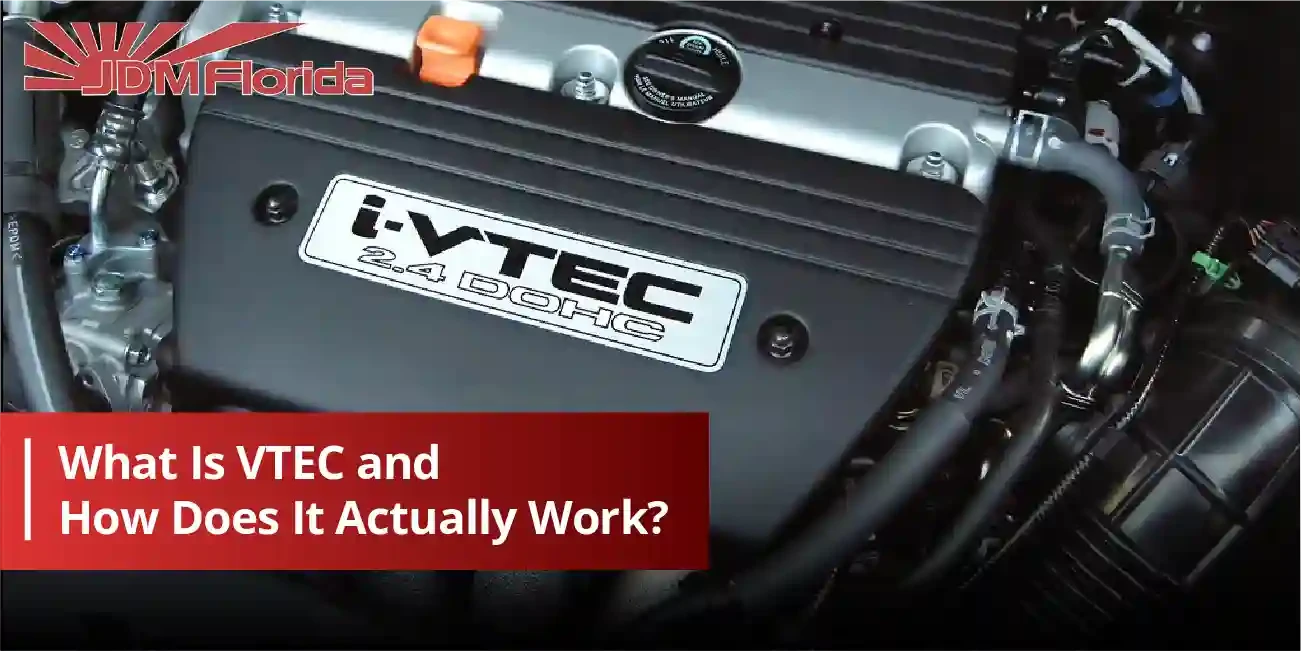
If you've spent any time around Honda fans, you've heard someone shout that VTEC just kicked in. But what is a VTEC engine, really, and why does it get so much attention? VTEC stands for Variable Valve Timing and Lift Electronic Control. It's a system Honda built to let one engine act like two. At low RPM, it runs smoothly and efficiently. At high RPM, it switches gears (not literally) and unlocks more power. This guide covers what VTEC is, how it works, and which engines use it, without the technical jargon that usually comes with this topic.
What is VTEC?
VTEC is Honda's way of solving an old engine problem. Every engine needs its camshaft to open and close valves at the right time. But a cam shape that works well at low speed doesn't work well at high speed, and vice versa. Engineers used just to pick one and live with the tradeoff.
Honda's answer was to build two cam profiles into a single camshaft. One profile handles daily driving. The other kicks in once the engine hits higher RPM, opening the valves wider and longer to let in more air. More air means more fuel can burn, and that means more power.
The system debuted in the late 1980s and quickly became one of Honda's signature technologies. If you're shopping around, you'll also want to check our collection on Honda engines to see which models come factory equipped with it.
How does VTEC work?
VTEC relies on oil pressure and a set of pins to switch between two sets of cam lobes. At low RPM, the engine runs on a mild cam profile built for fuel economy and smooth idling. Once the engine reaches a set RPM, the ECU sends pressurized oil to a locking pin. That pin connects the rocker arms to a more aggressive lobe, and the valve behavior changes almost instantly.
This isn't a gradual shift. It happens in a fraction of a second, which is part of why the VTEC kick feels so dramatic from the driver's seat.
Low cam vs high cam lobes
Think of the camshaft as having three lobes per cylinder pair: two outer lobes and one center lobe. The outer lobes are smaller and shaped for low-speed efficiency. The center lobe is bigger and more aggressive, built for high RPM airflow.
Under normal driving, the outer lobes do all the work. Once VTEC engages, the locking pin ties all three rocker arms together, and the center lobe takes over. The valves open sooner, stay open longer, and let in more air.
The VTEC crossover ("VTEC just kicked in")
The crossover point is the RPM where the system switches from the mild lobe to the aggressive one. On most Honda engines, this happens somewhere between 4,500 and 6,000 RPM, though the exact number depends on the engine.
Drivers usually feel a small surge and hear a change in exhaust note right at the crossover. That moment became so recognizable it turned into a meme, thanks in part to the Fast and Furious movies. But the science behind it is straightforward: more valve lift, more airflow, more power.
Types of VTEC
Not every VTEC system works the same way. Honda adapted the core idea for different engine layouts and different goals, from daily commuters to track-focused engines.
SOHC vs DOHC VTEC
SOHC VTEC engines use a single camshaft and typically apply VTEC to the intake valves only. These are common in economy-focused Hondas, where the goal is better fuel efficiency with a modest power bump at higher RPM.
DOHC VTEC engines use two camshafts, one for intake and one for exhaust, and often apply VTEC to both. This setup is more common in performance engines, like those found in the Civic Type R or certain Integra trims, and it produces a noticeably stronger top end.
i-VTEC explained
i-VTEC stands for intelligent VTEC. It pairs the standard VTEC lobe switching with Variable Timing Control, which adjusts the timing of the intake camshaft continuously, not just at one crossover point.
In simple terms, regular VTEC gives you two modes. i-VTEC gives you a sliding scale on top of those two modes, so the engine can fine-tune itself across a wider range of driving conditions. Most modern Honda engines use some version of i-VTEC rather than the original setup.
VTEC vs VVT and other variable valve systems
VTEC often gets grouped with other automakers' variable valve systems, but the approach isn't identical. Here's a quick comparison.
The biggest difference is that VTEC physically changes which lobe controls the valve, while systems like VVT-i mainly shift the timing of a single lobe. Neither approach is strictly better. They just solve the problem in different ways, and each automaker built its system around its own engine goals.
Which Honda engines have VTEC?
VTEC showed up across most of Honda's engine families starting in the late 1980s, though not every version of every engine had it. Some trims skipped VTEC entirely to keep costs down, so it's worth checking the specific engine code before buying.
B series, K series, F series, and J series
The B series engines, especially the B16 and B18, are probably the most famous VTEC engines among enthusiasts. They powered cars like the Civic Si, Integra, and Del Sol, and they're still popular swap candidates today.
The K series replaced the B series in the 2000s and brought VTEC into a more modern, higher-revving package, used in the Civic Type R, RSX Type S, and Accord.
The F series handled larger displacement applications, often in the Accord and Prelude, while the J series covered Honda's V6 lineup, including some Acura models. Both used VTEC, though tuned differently for their size and purpose.
If you're piecing together a swap, browse our Honda VTEC engine collection to see current B series and K series stock available for import.
Does VTEC actually make more power?
Yes, but the gain depends on the specific engine and how it's tuned. On most B and K series engines, VTEC adds a meaningful jump in horsepower at higher RPM, sometimes 20 to 30 percent more than the non-VTEC portion of the powerband.
However, VTEC isn't magic. It doesn't add power at every RPM, only above the crossover point. Below that, you're running on the mild cam profile, which is tuned more for economy than output. This is part of why VTEC engines can feel unremarkable in city driving but come alive on the highway or track.
How much does a VTEC engine cost?
Pricing varies a lot depending on the engine code, mileage, and whether you're buying a complete swap or a bare block. Rather than repeat all those numbers here, check our full breakdown in How Much Is a VTEC Engine? for current pricing across the most common VTEC options.
Where to buy a JDM VTEC engine
Buying used always carries some risk, so sourcing matters. Look for a seller who tests compression, checks for oil sludge, and backs the engine with an actual warranty rather than a vague promise.
At JDM Florida, every JDM engine we import from Japan gets inspected before it ships, and most come with up to 90 days of warranty coverage. That gives you a safety net most private sellers can't offer. According to Digital Trends' breakdown of how the VTEC system engages, understanding the mechanical side of this technology also helps buyers spot a healthy engine versus one that's been abused.
VTEC FAQs
What does VTEC stand for?
VTEC stands for Variable Valve Timing and Lift Electronic Control. The name describes exactly what it does: it changes valve timing and lift electronically, based on engine speed.
At what RPM does VTEC engage?
Most Honda VTEC engines engage somewhere between 4,500 and 6,000 RPM, though this varies by engine code and generation. Some tuners adjust this crossover point with aftermarket controllers, but factory settings are usually tuned for a balance of drivability and power.
VTEC isn't complicated once you break it down. It's a clever mechanical trick that lets one engine behave like two, giving Honda owners both efficiency and a real kick of power when it counts. Whether you're shopping for a swap or just trying to understand what's under your hood, knowing how VTEC works makes the whole system a lot less mysterious. If you're ready to start your build, take a look at our current JDM Honda engines for sale and find the right match for your project.